Deep Analysis of Hermetically Sealed Corrugated Tank Compensation Technology for H61 Transformers

This article analyzes fluid mechanics and electromagnetic stress in H61 pole-mounted transformer corrugated tanks, focusing on thermal compensation, fatigue life, and insulation.

Vziman
Field: Manufacturing
10Year<
China
Add us on Google

1. Introduction: Why the H61 Must Be "Hermetically Sealed"?

H61 pole-mounted transformers are frequently deployed in harsh outdoor overhead distribution networks, facing high temperatures, high salt spray, and frequent lightning strikes. Traditional conservator tank structures not only increase maintenance frequency (requiring regular checks of desiccants and oil filtration) but also allow the oil to oxidize and dampen due to contact with the atmosphere. The H61 adopts hermetically sealed corrugated tank technology, which balances the volume changes of the transformer oil through the elastic deformation of the tank walls, achieving the core of "zero-maintenance" design.

2. Physical Mechanism and Calculation of Thermal Expansion Compensation

During operation, the volume of transformer oil fluctuates significantly due to heat generated by load currents and environmental temperature differences. According to the formula:

ΔV=V0​×α×(Tmax​−Tmin​)

Where αα is the expansion coefficient of the transformer oil (approximately 0.0007/∘C0.0007/∘C).

In H61 design, the corrugated fins undertake all compensation tasks.

  • Compensation Capacity Design: Designers must ensure that the effective area and travel of a single corrugated plate can cover the volume increment from −25∘C−25∘C to +105∘C+105∘C (extreme conditions).
  • Pressure Equilibrium Point: Typically, the filling pressure at 20℃ is set to atmospheric or slight positive pressure to ensure no vacuum at low temperatures and that the yield stress of the corrugated plate is not exceeded at high temperatures.

3. Fatigue Stress and Material Life Analysis of Corrugated Fins

Since the H61 is installed outdoors, the frequent expansion and contraction of the corrugated plates caused by day-night temperature differences is essentially a low-cycle fatigue process.
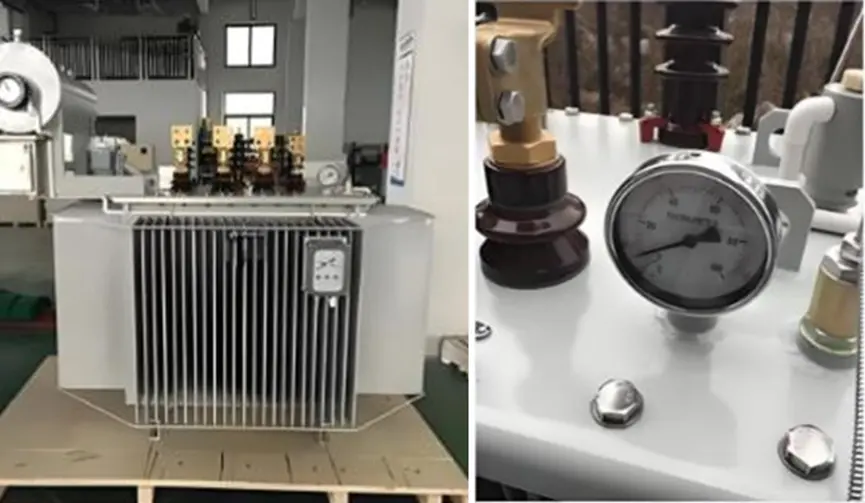
  • Material Selection: Typically, high-quality cold-rolled steel plates with a thickness of 1.2mm to 1.5mm are used, requiring high elongation and excellent welding performance.
  • Stress Concentration Points: The roots and top welding areas of the corrugated plates are the most concentrated stress regions. If there is incomplete welding or failure to release welding stress in the manufacturing process, long-term cyclic operation will lead to "corrugated plate cracking."
  • Internal Pressure Control: Typically, the internal operating pressure of H61 transformers should be controlled around 0.2∼0.3 bar0.2∼0.3 bar. If severe overloading causes abnormally high internal pressure, the corrugated plates will undergo permanent plastic deformation or even cause the tank to burst.

iee-business

4. Long-term Preservation Mechanisms for Insulation Performance

The hermetically sealed structure provides decisive protection for the internal insulation system:

  • Oxygen Isolation: Prevents the oxidation of transformer oil. Acidic substances produced by oil oxidation accelerate the degradation of insulation paper (decrease in degree of polymerization, DP).
  • Moisture Isolation: Atmospheric water vapor cannot intrude, ensuring the dielectric strength between windings and significantly slowing the sedimentation rate of impurities in the oil.
  • Air Gap Reduction: Since there is no oil conservator, the risk of partial discharge (PD) caused by bubbles generated during operation is reduced.

5. Expert Maintenance Perspectives: Identifying Potential Hazards

Drawing on nearly 30 years of engineering experience, vigilance is required for the following phenomena when maintaining H61 transformers:

  • "Corrugation Dead Zone": Observe whether the corrugated plates have obvious permanent expansion. If the corrugated plates are fully extended and cannot retract with temperature, it indicates internal overloading or gas generated by internal faults.
  • Infrared Thermal Imaging: Focus on scanning the sediment areas at the bottom of the corrugated plates. Although the hermetically sealed design isolates external pollution, metallic particles or aging residues generated internally will deposit at the bottom, and poor local heat dissipation may cause corrosion and oil leakage.
  • Bushing Gasket Aging: This is the only non-metallic connection point in the hermetically sealed system. Long-term exposure to ultraviolet radiation and temperature differences causes gasket hardening and failure, leading the system to turn "from sealed to open," rapidly deteriorating oil quality.

6. Conclusion

The hermetically sealed corrugated tank of the H61 is not only an embodiment of compact space but also a core means of achieving long equipment life through material mechanics. Its essence lies in the balance between flexible compensation and physical isolation. In the future digitalization of the power grid, monitoring internal pressure by adding strain gauges to the corrugated tank walls will be an important direction for achieving Condition-Based Maintenance (CBM) for H61.


Give a tip and encourage the author!

Comments

Share your question or perspective
WhatsApp
Send inquiry
+86
Click to upload file
Download
Get the IEE Business Application
Use the IEE-Business app to find equipment, obtain solutions, connect with experts, and participate in industry collaboration anytime, anywhere—fully supporting the development of your power projects and business.
Login
or continue with
New here?
Register







