A copper wire is 2.0 mm thick and 2 meters long. What is the resistance?

Learn how to calculate the resistance of a copper wire using the resistivity formula. Step-by-step guide with example: find cross-sectional area, apply formula R= A ρL ​ , and compute resistance for a 2m wire with 2mm diameter.

Encyclopedia
Field: Industry News
Electrical Engineer
10Year<
China
Add us on Google

To calculate the resistance of a copper wire, we can use the resistivity formula:


ebdff453c1c4b00dd1a906419af0d5e6.jpeg


  • R is resistance (unit: ohms, Ω)


  • ρ is the resistivity of the material (unit: ohms · meters, Ω·m)


  • L is the length of the wire (unit: m, m)


  • A is the cross-sectional area of the wire (unit: square meters, m²)


For copper wires, the resistivity is approximately 1.72×10⁻⁸Ω⋅m (the standard value at 20°C).


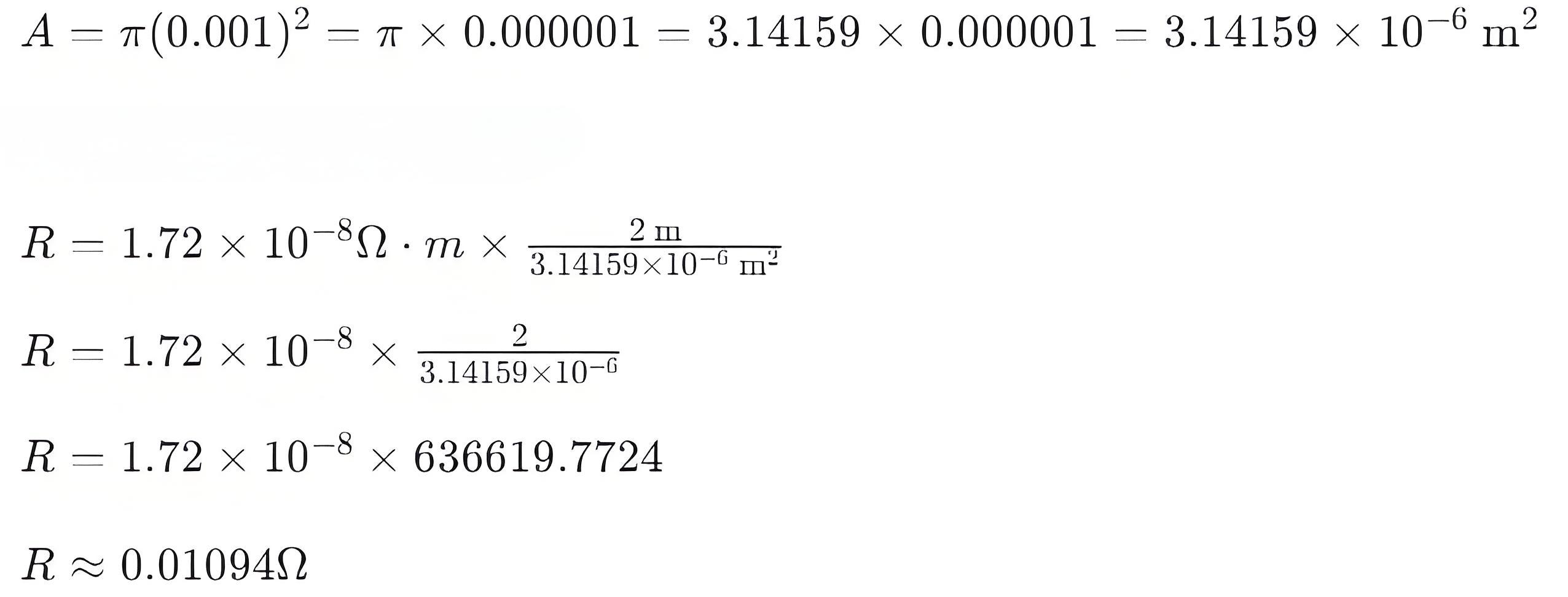
First, we need to calculate the cross-sectional area A of the wire. Suppose the wire has a circular cross-section and a diameter of 2.0 mm, so the radius r is 1.0 mm, or 0.001 m. The formula for the area of A circle is A=πr 2, so:

99e2d9b3f008ef470a5fa196aecb3be6.jpeg


Therefore, a copper wire with a diameter of 2.0 mm and a length of 2 meters has a resistance of about 0.01094 ohms under standard conditions (20°C). Note that the actual resistance value may vary slightly depending on the quality of the copper, temperature, and other factors.


Give a tip and encourage the author!

Comments

Share your question or perspective
WhatsApp
Send inquiry
+86
Click to upload file
Download
Get the IEE Business Application
Use the IEE-Business app to find equipment, obtain solutions, connect with experts, and participate in industry collaboration anytime, anywhere—fully supporting the development of your power projects and business.
Login
or continue with
New here?
Register