AC Voltage Converter – Peak, Peak-to-Peak, and RMS
Convert between peak, peak-to-peak, and RMS voltage values in AC signals. Ideal for electrical engineering, circuit design, oscilloscope analysis, and academic studies. Includes formulas, examples, and a visual waveform diagram.
Core Formulas
| Conversion | Formula |
|---|---|
| RMS → Peak | V_peak = V_rms × √2 ≈ V_rms × 1.414 |
| Peak → RMS | V_rms = V_peak / √2 ≈ V_peak / 1.414 |
| Peak → Peak-to-Peak | V_pp = 2 × V_peak |
| Peak-to-Peak → Peak | V_peak = V_pp / 2 |
| RMS → Peak-to-Peak | V_pp = 2 × V_rms × √2 ≈ V_rms × 2.828 |
| Peak-to-Peak → RMS | V_rms = V_pp / (2 × √2) ≈ V_pp / 2.828 |
Parameters
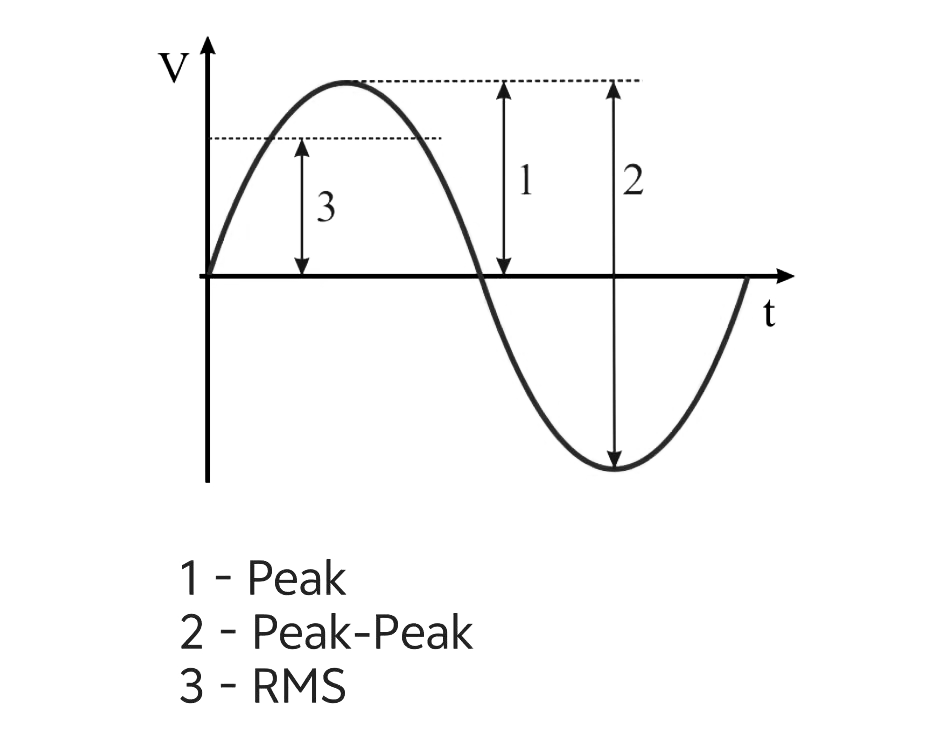
- Peak (Vpeak): The maximum instantaneous voltage in one cycle of an AC waveform, unit: Volts (V)
- Peak-to-Peak (Vpp): The difference between the maximum and minimum voltage values, representing the total swing of the signal
- RMS (Vrms): Root-Mean-Squared value, equivalent to the DC voltage that would produce the same heating effect. Mains electricity (e.g., 230V) is specified as RMS
Visual Waveform Diagram
Example Calculations
Example 1: Household AC Voltage
Household mains voltage RMS = 230 V
- Peak: 230 × 1.414 ≈ 325.2 V
- Peak-to-Peak: 325.2 × 2 ≈ 650.4 V
Example 2: Signal Generator Output
Signal generator output Peak-to-Peak = 10 V
- Peak: 10 ÷ 2 = 5 V
- RMS: 5 ÷ 1.414 ≈ 3.54 V
Use Cases
- Electrical measurements and instrument calibration — ensuring accuracy of multimeters and oscilloscopes
- Circuit design and component selection — choosing diodes, capacitors, and transformers based on peak voltage
- Signal analysis and oscilloscope interpretation — reading waveforms from test equipment
- Academic learning and exams — understanding AC theory, power systems, and electronics
Frequently Asked Questions (Based on Google "People Also Ask")
What is the difference between peak and RMS voltage?
Peak voltage is the maximum amplitude of the AC waveform.
RMS voltage is the effective value, equivalent to the DC voltage that delivers the same power.
For sine waves: Vrms = Vpeak / √2 ≈ Vpeak / 1.414.
Why is household voltage given as RMS?
Because RMS represents the equivalent heating effect of DC. A 230V RMS AC supply delivers the same power as a 230V DC source, making it easier to compare and use in practical applications.
How do I convert RMS to peak voltage?
Multiply RMS by √2 (≈1.414):
V_peak = V_rms × 1.414
Example: 120V RMS → 120 × 1.414 ≈ 169.7 V peak
Is peak-to-peak voltage twice the peak voltage?
Yes! For a symmetric AC waveform:
V_pp = 2 × V_peak
This is because the signal swings from +V_peak to -V_peak.
Can this calculator be used for non-sinusoidal waves?
No. These formulas are only accurate for sinusoidal waveforms. For square or triangular waves, different RMS relationships apply.
What does RMS stand for?
RMS stands for Root Mean Square. It is calculated as:
V_rms = √(average of V² over one cycle)
It gives the effective value of an AC signal.
Reference Standards
- IEC 60050: International Electrotechnical Vocabulary
- IEEE 145-2017: Standard for Electric Power Systems and Equipment
- Textbooks: "Electric Circuits" by Nilsson & Riedel, "Fundamentals of Electric Circuits" by Alexander & Sadiku